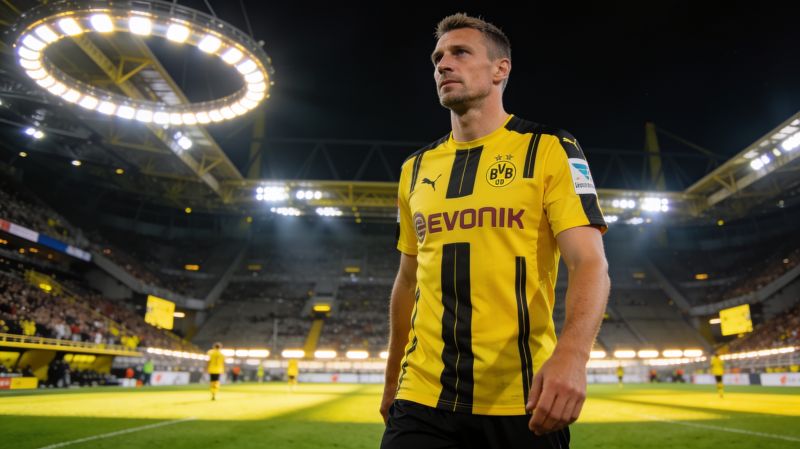
Łukasz Piszczek remains one of the clearest symbols of Borussia Dortmund’s modern revival, even after stepping away from the professional game. His influence was built less on dramatic speeches than on relentless movement down the right flank。sharp defensive judgment and a calmness that rarely matched the noise around him. During his eleven years at Dortmund, Piszczek became a trusted figure through title-winning seasons, painful European defeats and several serious injuries. Supporters at Signal Iduna Park did not simply admire Piszczek as a full-back. They treated him as evidence that discipline and loyalty could still shape a major football career.Piszczek arrived at Dortmund in 2010 after beginning his senior career in Poland and spending time with Hertha BSC. The move initially looked like a useful addition rather than a headline transfer. That changed quickly. Under Jürgen Klopp, Piszczek developed into an aggressive modern full-back who could defend deep, overlap at speed and deliver dangerous crosses without abandoning his position. His partnership with Mario Götze and Jakub Błaszczykowski on the right gave Dortmund a direct attacking route that opponents struggled to contain. Piszczek helped the club win back-to-back Bundesliga titles in 2011 and 2012, while the 2012 domestic double confirmed Dortmund’s return to Germany’s elite.The 2012-13 Champions League campaign placed Piszczek on a larger stage. Dortmund’s run to the final featured fast transitions, bold pressing and a squad that played with unusual confidence. Piszczek started the final against Bayern Munich at Wembley despite dealing with a hip problem, a decision that captured both his importance and his stubborn competitiveness. Bayern won 2-1, but Piszczek’s performance reinforced his reputation as a player willing to operate through discomfort when the team needed him. His career was not free from controversy or setbacks. A 2011 betting-related case in Poland led to a ban and public criticism。
but Piszczek accepted responsibility and continued rebuilding his standing through performances rather than public campaigning.Injuries later became a recurring obstacle. Hip surgery, muscular problems and the physical demands of playing as an attacking full-back reduced his availability。yet Piszczek repeatedly returned to the starting lineup. He also adapted tactically, moving into a more conservative role and using experience to compensate for lost acceleration. That adjustment mattered. Younger defenders could run faster, but Piszczek often read danger earlier, choosing the correct angle before an opponent had created a problem. His final years at Dortmund carried a quieter emotional weight. There were fewer spectacular overlaps, but every appearance reflected a player who understood the club’s standards and the expectations attached to its yellow-and-black shirt.Piszczek left Dortmund in 2021 and returned to Poland, where he continued playing for LKS Goczałkowice-Zdrój while building a life beyond top-level football. His connection with Dortmund did not disappear. In 2024。Piszczek returned to the club as part of the coaching staff, bringing practical knowledge of defensive organization, transition play and the daily pressure surrounding a famous team. The appointment made sense: Piszczek knows the Bundesliga from the inside, understands the emotional culture of Dortmund and has experienced the demands of international football with Poland. His legacy is not based on being the loudest or most fashionable player of his generation. Piszczek’s case is more durable than that. He made reliability look distinctive, and in a sport often drawn to short-term brilliance, that remains a powerful achievement.